Choosing an upright, comfort-oriented bicycle for short casual riding, covering frame geometry, gearing, braking and the real cost of getting one road-ready
Flat streets, two-mile errands, and the point where an upright bike stops being enough
Upright geometry, fat tires and swept bars make short flat trips pleasant, but distance, grade and cargo change the math, and so does the bill to get one road-ready.
Vertical spine, loaded saddle
An upright riding position puts nearly all of your weight on the saddle instead of splitting it between hands, feet and seat. That is comfortable at low effort and becomes the limiting factor as effort rises.
Tire volume as suspension
Two-inch tires at low pressure do most of the comfort work on a cruiser, smoothing expansion joints and driveway lips before they reach your wrists. Swapping to narrow tires removes the single biggest source of ride quality.
Slow steering is deliberate
A slack head angle and long fork make the bike track straight with a light hand, which is why it feels stable at walking pace. The same geometry makes quick evasive moves less crisp.
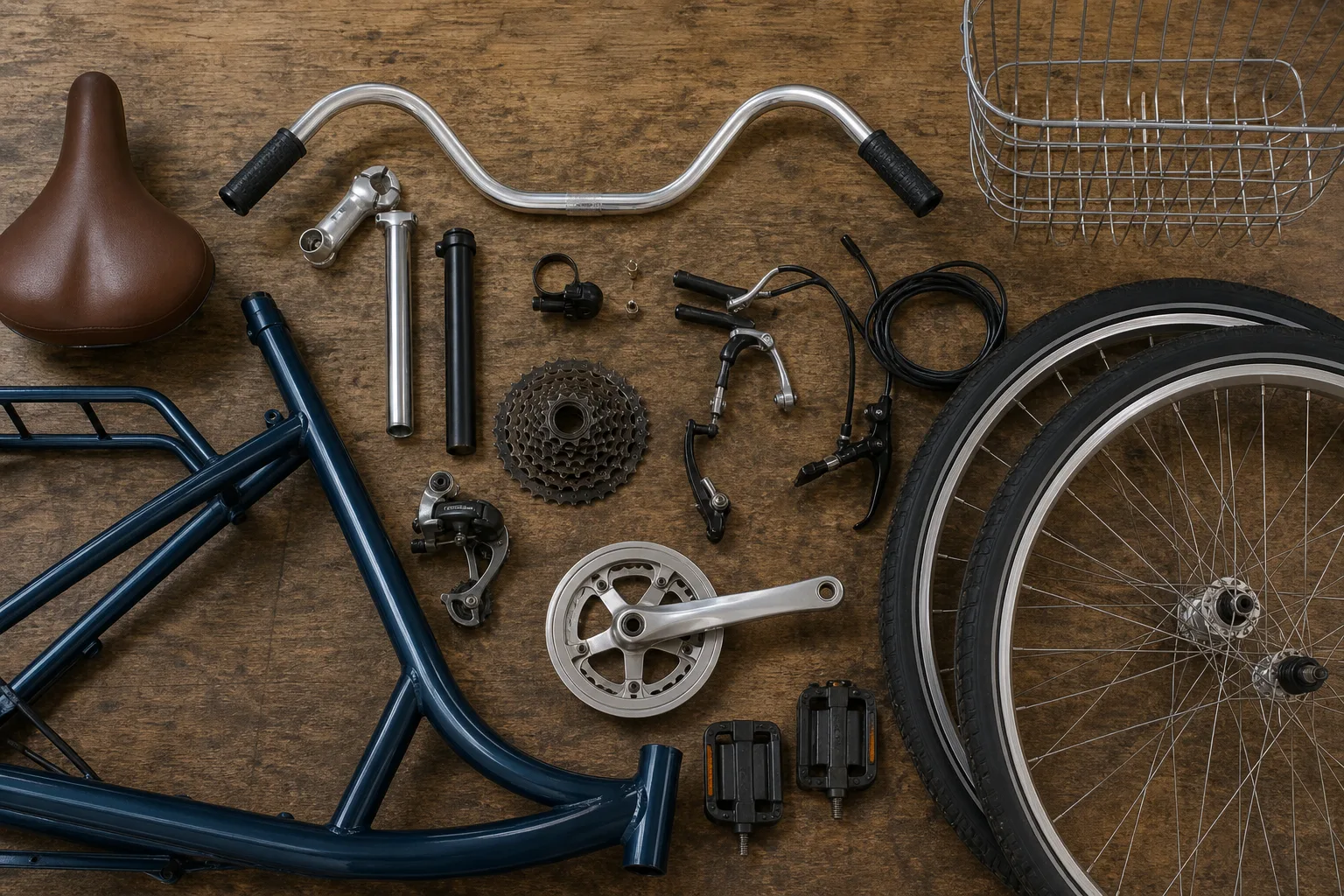
The riding position is the whole argument. On an upright frame you sit with your spine close to vertical, your hands low and wide on swept bars, and your weight carried mostly by the saddle rather than shared with your palms and shoulders. That arrangement is comfortable at eight miles an hour on flat pavement and progressively less comfortable as speed, grade or distance climbs, because everything that makes it pleasant at low effort works against you the moment you need to put power down or cut through a headwind.
What the geometry actually buys you
Three things travel together on these bikes and they are worth separating. The head tube is slack and the fork is long, which slows the steering and makes the bike track straight with a light hand. The tires are wide, commonly in the two-inch neighborhood, run at low pressure, and they absorb the seams, gravel and driveway lips that a narrow tire transmits straight into your wrists. The bars sweep back so your forearms rotate into a natural position. Together they produce a bike that is forgiving of inattention, which is most of what casual riding asks for.
The second-order effect is the one people miss. A slack, long-wheelbase frame with a saddle set behind the cranks puts your hips in a position where you cannot easily stand and drive on the pedals, because your body weight is behind the bottom bracket rather than above it. On flat ground that never comes up. On a six percent grade it comes up immediately, and no amount of gearing entirely compensates, since the limit is skeletal rather than mechanical. The bike is not slow. It is geometrically committed to sitting.
Where the crossover happens
Distance is the crudest indicator and the least reliable one. Two miles each way on flat streets is comfortably inside the envelope for almost anyone. Five miles is fine if the route is genuinely flat and you are not in a hurry. Past that, the fixed position starts to matter, because a single hand and hip posture held for forty minutes gets tiring in a way that a bike with two or three usable hand positions does not. Grade matters more. Any sustained climb over about a mile, on anything steeper than a gentle rise, tips the decision toward a hybrid.
Cargo is the third variable and the one that changes fastest. A rear rack with twenty pounds of groceries on an upright frame sits well behind the rear axle on many designs, which lightens the front end and makes the already-slow steering feel vague. The frame is usually strong enough; the handling is the constraint. If you are regularly carrying a case of anything, a child seat or a full pannier set, a light touring frame with a rack mounted close to the axle and a longer chainstay is the better tool, and the price difference is smaller than most people assume.
What it costs to get one road-ready
The sticker price is not the price. A boxed bike arrives with the front wheel, bars, seatpost, pedals and often the front brake left to whoever opens the carton, and the factory build is a starting point, not a finished bicycle. Expect to pay a shop somewhere in the range of a hundred dollars or more for a full assembly and safety check, and expect the check to find something: brake pads set too far from the rim, a rear hub cone that needs adjustment, spoke tension that has never been evened out, or a derailleur hanger bent in shipping. None of those are unusual and all of them are fixable.
The parts that follow are worth budgeting separately. A saddle you can sit on for thirty minutes, a set of tires with a puncture belt if your streets carry glass, lights that meet the requirement for riding after dark, a lock that matches what your neighborhood actually loses, and a rack and basket if you plan to carry anything at all. Shops that sell Cruiser Bikes will usually quote all of that together, and getting the quote in writing before you buy is the cheapest hour you will spend on the project.
The Consumer Product Safety Commission is responsible for bicycle safety requirements in the United States, which covers things like reflectors, braking performance and the way a bike is supposed to leave the factory. That is a floor, not a specification for your route. A bike that clears the federal requirement can still have a brake reach your hand cannot close, a coaster hub you do not want on a hill, or a stem height that puts you in a position you will abandon within a month. The shop visit is where those get sorted, and it is worth paying for.
Making the call
Ride the route you actually have, not the route you imagine. Count the climbs, note where you have to accelerate from a stop into traffic, and be honest about how often the trip involves carrying something heavier than a laptop. If the answers are flat, unhurried and light, the upright bike is not a compromise, it is the correct answer, and it will be more pleasant than a faster bike would be. If two of the three answers point the other way, the extra few hundred dollars for a hybrid buys back the capability you would otherwise spend years wishing for.
The one thing worth resisting is buying the upright bike and then trying to make it into the other bike, since drop bars, narrow tires and aggressive gearing on a frame designed around a vertical spine produce something that does neither job well and costs more than either.
Written while replacing a heavy hand-me-down with something suited to flat streets and a two-mile errand. Covers where balloon-tyre uprights part company with hybrids, and what a shop does to a bike that a carton does not.
The two-mile sweet spot
Short flat errands of a couple miles each way sit comfortably inside what upright geometry does well. Beyond roughly five miles, the single fixed hand position starts to tire riders who would be fine on a hybrid.