Coaster brake or hand brakes? What the box leaves for you to finish
Reclaim CA Higher Ed- Subject
- Choosing an upright, comfort-oriented bicycle for short casual riding, covering frame geometry, gearing, braking and the real cost of getting one road-ready
- Editor
- The Reclaim CA Higher Ed team
- Subject
- Choosing an upright, comfort-oriented bicycle for short casual riding, covering frame geometry, gearing, braking and the real cost of getting one road-ready
A coaster brake acts only on the rear wheel, which carries less weight the harder you slow down. That sets a floor under how short a stop the bike can make.
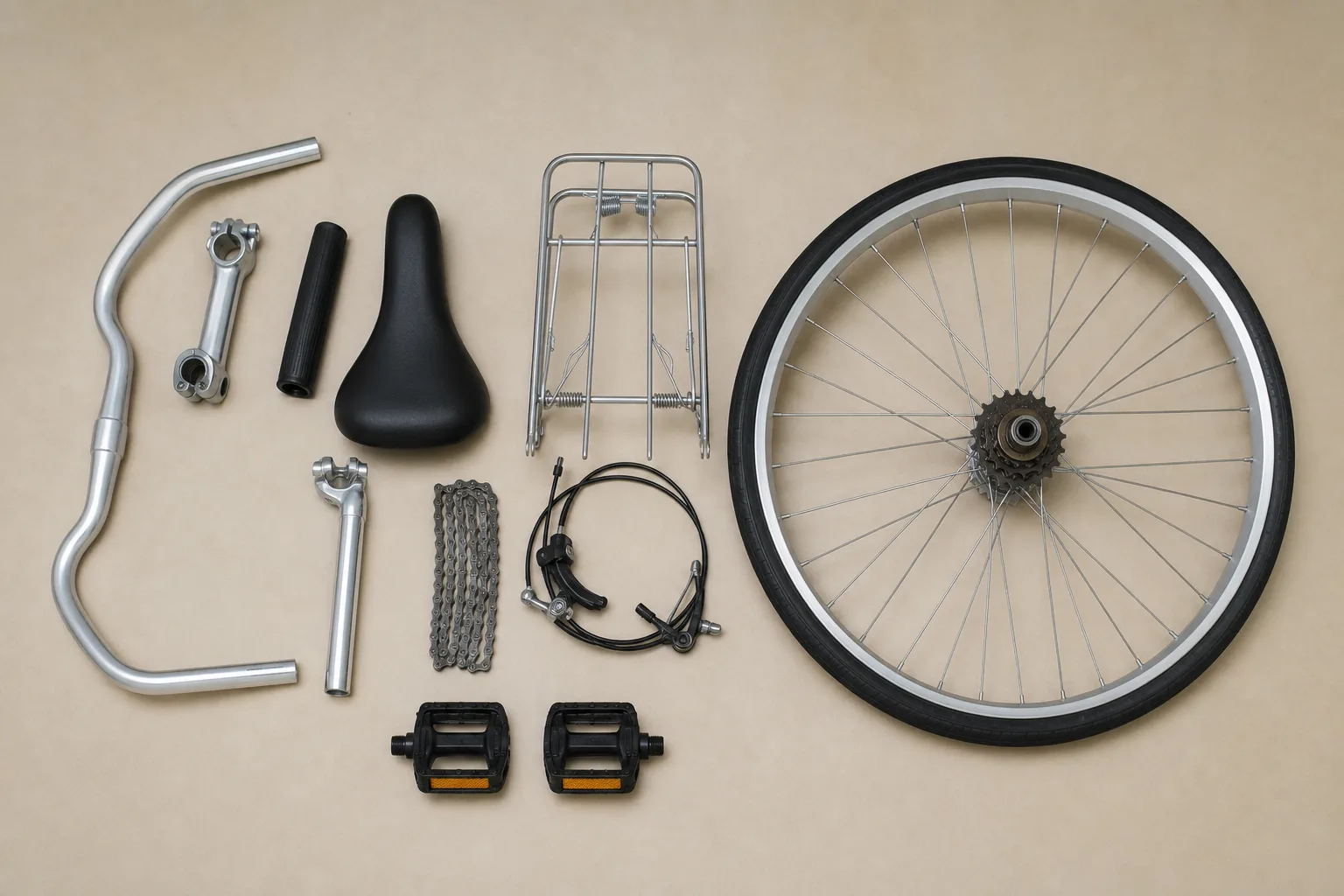
The most consequential difference between two otherwise identical cruisers on the same sales floor is usually invisible until you stop pedaling. One coasts. The other resists, then bites, because the rear hub contains a brake that engages when the cranks turn backward. Both bikes will get you two miles to the hardware store and back. They will not behave the same way on a wet manhole cover, on the one steep block on your route, or after a winter of being left outside, and the second-order costs of that difference show up in the assembly, not the sticker.
1. What back-pedaling does well, and the two places it thins out
A coaster brake is enclosed, so grit and rain reach it slowly, and it needs no cable, lever, or pad adjustment for years at a stretch. That is a real advantage on a bike stored on a porch. The limits are geometric rather than mechanical: it acts on the rear wheel only, and when you decelerate, weight shifts forward and the rear tire loses grip in proportion. On a descent, the hub also absorbs heat with nowhere to shed it, and sustained dragging produces fade. Wet pavement compounds both effects at once.
2. Why the front wheel matters more than most riders expect
Braking transfers load onto the front contact patch, which is why a front rim or disc brake can generate most of the stopping force available on a level street. A rear-only bike is not unsafe at ten miles an hour on flat ground, but its shortest stop is longer, and the margin narrows further when the road is slick. Adding a front hand brake to a coaster-equipped cruiser is a common and inexpensive retrofit, provided the fork has a mounting bridge and the bars have room for a lever. A careful reader checks for that bridge before buying.
3. The reason budget bikes arrive with one brake
Every cable is a part, a routing decision, a lever, a housing, and roughly a minute of a builder's time, multiplied across a container. Deleting the front brake removes all of it. The bike still meets the federal requirements that the Consumer Product Safety Commission is responsible for overseeing for bicycles sold in the United States, and it still coasts to a stop in a parking lot demonstration, so the omission rarely registers at purchase. What it produces later is a bike whose stopping distance is set by one tire, on the light end of the frame, in whatever weather the errand happens to fall in.
4. What the carton skips inside the hubs and wheels
A boxed bike is assembled to a schedule, and the parts that suffer are the ones nobody sees. Cup-and-cone hubs leave the factory either too tight, which grinds the bearing races, or loose enough to develop play that a rider reads as a vague front end. Wheels are tensioned by machine and rarely trued afterward, so spokes settle unevenly in the first fifty miles and the rim starts to wander. A shop build stresses the spokes, corrects the lateral hop, sets cone preload by feel, and repacks anything that arrived dry. That work is why a shop bike stays quiet.
5. Torque, the reaction arm, and the fasteners worth naming
A coaster hub does not float: it transmits its braking force into the frame through a reaction arm strapped to the left chainstay, and if that strap is loose, misaligned, or torqued by guess, the whole assembly can rotate under load. The same applies to axle nuts, stem bolts, seat post clamps, and crank bolts, each of which has a specified figure printed nearby or listed by the manufacturer. Over-tightening a stem bolt into an aluminum steerer is as expensive a mistake as leaving it loose. A careful reader asks whether a torque wrench touched the bike.
6. The checks worth making before you pay
Lift the front wheel and spin it, listening for a rub and watching the rim against the fork blade. Rock each wheel side to side at the rim for bearing play. Squeeze any lever to the bar and see how much travel remains. Back-pedal a quarter turn and note how quickly the brake engages, since a long dead spot means the hub needs attention. Confirm the reaction arm strap is bolted, not merely resting. These take four minutes, and they tell you exactly how much finishing work the price you are about to pay includes.
The bike that arrives ready is not a different machine from the one in the box. It is the same machine with an hour of skilled attention already spent, and knowing which hour you are buying makes the comparison between two prices an honest one.